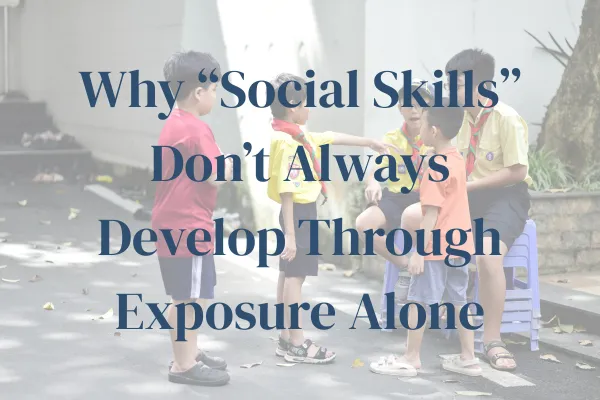
Why “Social Skills” Don’t Always Develop Through Exposure Alone
Why “Social Skills” Don’t Always Develop Through Exposure Alone
A common belief in autism support is:
“If we expose autistic children to enough neurotypical peers, they will eventually learn social skills naturally.”
But for many children, this approach can unintentionally create stress rather than learning.
Social interaction is not just about observing other children. It requires:
emotional regulation
processing speed
understanding nonverbal cues
flexible thinking
managing unpredictability
responding in real time
For autistic children, trying to manage all of these demands at once can be overwhelming.
Some children become passive in group play and simply “go along” without truly understanding the interaction. Others may take control of the play to make the experience feel more manageable and predictable.
This is not “bad behaviour.”
It is often a nervous system trying to stay regulated.
One of the most important things we can do is create social experiences that feel accessible and emotionally safe.
This may include:
smaller groups
slower-paced activities
shared interests
adult-supported play
clear structure
and opportunities to interact with peers who communicate similarly
Parents sometimes worry that friendships with other autistic children will somehow “limit” social growth.
In reality, these relationships often build the exact foundations children need:
confidence
reciprocity
emotional safety
flexibility
shared joy
and authentic connection
Once children feel socially successful somewhere, they are often better able to generalise those skills into broader environments over time.
Social development should not feel like constant survival.
Children learn best when they feel safe enough to participate.
If you would like to explore this more feel free to book a 30 minute discovery call by visiting my website -earlyinterventionclinic.co.uk